Private Placements: Finding Value Beyond the Illiquidity Premium
By Jonathan Stanley, Director – Portfolio Management; Samuel Otchere, Director – Private Placements
Private placements have long offered insurance investors the potential for incremental yield, negotiated covenant protections, and cash flows tailored to their liabilities.
Conning’s analysis cites a typical illiquidity premium of 10 to 40 basis points above comparable public corporate bonds for traditional transactions, with premiums potentially exceeding 100 basis points for more structured transactions, such as leases and project finance.
These ranges, however, do not tell the full story. Not all incremental spread represents compensation for illiquidity.
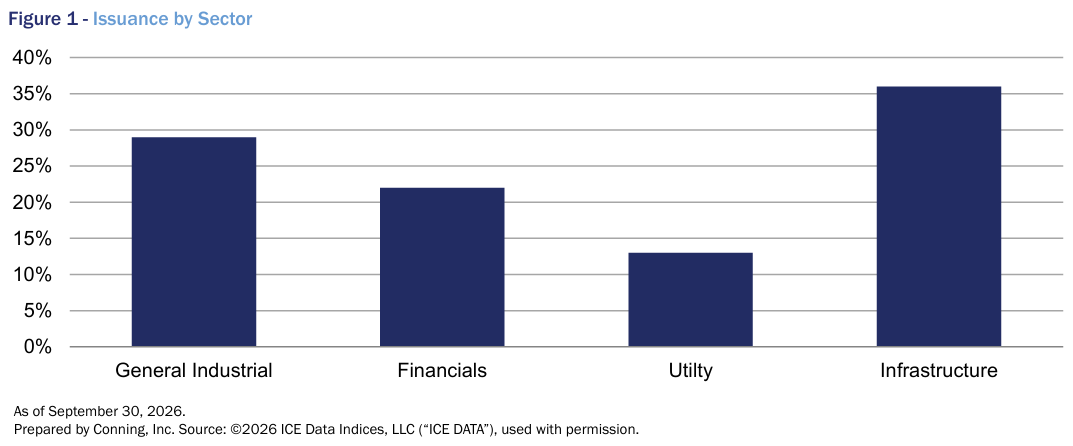
According to Conning’s 2026 Insurance Investment Risk Survey, 51% of respondents expected to increase their allocations to private placements in 20261. At the same time, the opportunity set continues to span a wide range of issuers, sectors, and financing structures, including digital infrastructure, power and utilities, transportation and asset-backed transactions.
Private placement issuance has also remained strong in 2026, with the market potentially on pace to exceed the record supply reached in 2025. This growth is expanding the range of potential investments, while reinforcing the importance of disciplined underwriting and relative-value assessment.
These developments bring additional underwriting considerations. Investors must assess not only the yield available, but also the risks being assumed, the protections provided, and how each transaction compares with alternatives in public and private markets.
Looking Beyond Spread
Spread alone does not capture the full investment proposition of a private placement. Negotiated covenants may restrict additional borrowing, asset transfers, or other actions that could weaken a creditor’s position. Direct access to management can also support due diligence and ongoing monitoring.The strength of these protections varies by transaction. Covenants must be evaluated for their terms and enforceability, particularly when assessing potential recovery outcomes if an issuer’s financial condition deteriorates.
Some opportunities require expertise beyond traditional corporate credit analysis. Infrastructure and project finance transactions may involve detailed assessments of asset-level cash flows and contractual arrangements. Asset-backed financings depend on collateral quality and repayment structures, while cross-border investments introduce additional legal and jurisdictional considerations.
The additional spread associated with these transactions may reflect structural complexity, specialized underwriting requirements, or other risks beyond reduced liquidity. That complexity, however, is not inherently valuable. The potential return must justify the additional risks.
Comparisons with public investment-grade bonds therefore extend beyond spread differentials. Capital structure positioning, covenant quality, recovery prospects, and diversification benefits can materially influence relative value. A modest spread premium may be attractive when accompanied by meaningful protections, while a
higher premium may not compensate for excessive leverage or unfavorable terms.
Selectivity as an Investment Advantage
A growing market creates more opportunities to invest, but not necessarily more investments worth making.Over the last decade, Conning’s annual participation ratio has averaged 23%, reflecting a selective approach to capital deployment. Investment decisions consider not only issuer fundamentals and relative value, but also transaction structure, covenant protections, portfolio fit, and the adequacy of compensation for risk. This discipline is supported by fundamental credit analysis, legal review, and investment committee oversight.
Transactions may be declined for insufficient compensation, weak structures, excessive leverage, deteriorating fundamentals, or an inadequate fit with portfolio objectives. Avoiding investments with unfavorable risk characteristics is an important part of protecting long-term portfolio performance.
Investment decisions must also account for portfolio-level considerations. A transaction may offer attractive credit fundamentals and structural protections but provide limited value if it introduces unwanted concentration, conflicts with duration targets, or consumes disproportionate risk capital. Liquidity requirements and existing exposures can be just as important as the merits of an individual security.
Footnotes
1 Source: Conning, Inc.’s 2026 Investment Risk Survey (https://go.conning.com/Investment-Risk-Survey-Viewpoint-0226)
About Conning
Conning (www.conning.com) is a leading investment management firm with a long history of serving insurance companies and other institutional investors. Conning supports clients with investment solutions, risk modeling software, and industry research. Founded in 1912, Conning has investment centers in Asia, Europe and North America. Conning is part of Generali Investments Holdings S.p.A.
Legal Disclaimer
©2026 Conning, Inc. Conning, Inc., Goodwin Capital Advisers, Inc., Conning Investment Products, Inc., a FINRA-registered broker-dealer, Conning Asset Management Limited, and Conning Asia Pacific Limited (collectively “Conning”) and Octagon Credit Investors, LLC, Global Evolution Holding ApS and its subsidiaries, MGG Investment Group LP and certain of its affiliates, and Pearlmark Real Estate, L.L.C. and its subsidiaries (collectively “Affiliates” and together with Conning, “Conning & Affiliates”) are all direct or indirect subsidiaries of Conning Holdings Limited which is one of the family of companies whose controlling shareholder is Generali Investments Holding S.p.A. (“GIH”) a company headquartered in Italy. Assicurazioni Generali S.p.A. is the ultimate controlling parent of all GIH subsidiaries. Conning & Affiliates have investment centers in Asia, Europe and North America. This document and the software described within are copyrighted with all rights reserved. No part of this document may be distributed, reproduced, transcribed, transmitted, stored in an electronic retrieval system, or translated into any language in any form by any means without the prior written permission of Conning & Affiliates. Conning & Affiliates do not make any warranties, express or implied, in this document. In no event shall any Conning & Affiliates company be liable for damages of any kind arising out of the use of this document or the information contained within it. This document is not intended to be complete, and we do not guarantee its accuracy. Any opinion expressed in this document is subject to change at any time without notice.
This document is for informational purposes only and should not be interpreted as an offer to sell, or a solicitation or recommendation of an offer to buy any security, product or service, or retain Conning & Affiliates for investment advisory services. The information in this document is not intended to be nor should it be used as investment advice.
Copyright 1990-2026 Conning, Inc. All rights reserved.
Disclosures
Past performance is not a guarantee, predictor or indication of future results. Similar investments likely would produce different results under different economic and market conditions.
Additional Source Information
ICE Data Indices, LLC (“ICE DATA”), is used with permission. ICE DATA, ITS AFFILIATES AND THEIR RESPECTIVE THIRD PARTY SUPPLIERS DISCLAIM ANY AND ALL WARRANTIES AND REPRESENTATIONS, EXPRESS AND/OR IMPLIED, INCLUDING ANY WARRANTIES OF MERCHANTABILITY OR FITNESS FOR A PARTICULAR PURPOSE OR USE, INCLUDING THE INDICES, INDEX DATA AND ANY DATA INCLUDED IN, RELATED TO, OR DERIVED THEREFROM. NEITHER ICE DATA, ITS AFFILIATES NOR THEIR RESPECTIVE THIRD PARTY SUPPLIERS SHALL BE SUBJECT TO ANY DAMAGES OR LIABILITY WITH RESPECT TO THE ADEQUACY, ACCURACY, TIMELINESS OR COMPLETENESS OF THE INDICES OR THE INDEX DATA OR ANY COMPONENT THEREOF, AND THE INDICES AND INDEX DATA AND ALL COMPONENTS THEREOF ARE PROVIDED ON AN “AS IS” BASIS AND YOUR USE IS AT YOUR OWN RISK. ICE DATA, ITS AFFILIATES AND THEIR RESPECTIVE THIRD PARTY SUPPLIERS DO NOT SPONSOR, ENDORSE, OR RECOMMEND CONNING, OR ANY OF ITS PRODUCTS OR SERVICES.
Risks Associated with Private Placements include, but are not limited to, the following:
Market Risk – Market, or systematic, risk is the risk that individual securities may be correlated with general market downturns regardless of the particular business conditions and outlook for the individual companies
Credit Risk – Eroding fiscal health in issuing companies resulting in inability to meet debt obligations
Inflation Risk – Inflation erodes the purchasing power of future cash flows from investments. In times of high inflation the value of securities may be reduced
Liquidity Risk – Liquidity risk can occur when market conditions do not allow transactions to be made in a quick and orderly fashion in relation to indicative market price
COD00003002