The Next Phase of Life Insurance Investing: Balancing Opportunity, Complexity and Capital
By Matt Reilly, Managing Director - Insurance Solutions
The U.S. life and annuity industry entered 2026 from a position of strength. Earnings growth has supported higher surplus levels and stronger balance sheets, while individual annuity sales reached new records. Sales of registered index-linked annuities (RILAs) and fixed indexed annuities (FIAs) have been particularly strong, supported in part by favorable demographic trends. Conning believes that recent indicators suggest that 2026 may be another strong sales year.
Individual life insurance has also performed well. New annualized life insurance premiums increased 10% to more than $17.5 billion, while the number of policies sold rose 7%.1 At the same time, elevated book yields and strong returns from alternative and other risk assets have continued to support industry earnings.
However, the operating environment is evolving. Industry success is attracting new entrants and additional capital, increasing competitive pressure and the need for product differentiation. At the same time, potential lower interest rates or further spread compression could weigh on product demand and investment yields. Growing allocations to private credit and other less liquid or complex assets are also drawing increased scrutiny.
Against this backdrop, Conning believes that investment strategy may become an increasingly important differentiator for life and annuity insurers. Carriers have access to a broader range of investment opportunities, but must balance return objectives with liquidity, capital efficiency, asset-liability management and risk across the portfolio. How insurers navigate these trade-offs may have a meaningful effect on their ability to sustain profitable growth as market conditions evolve.
Understanding the forces reshaping life and annuity portfolios will therefore be critical as insurers position themselves for the next phase of the market cycle.
Life Insurer Asset Allocations Continue to Evolve
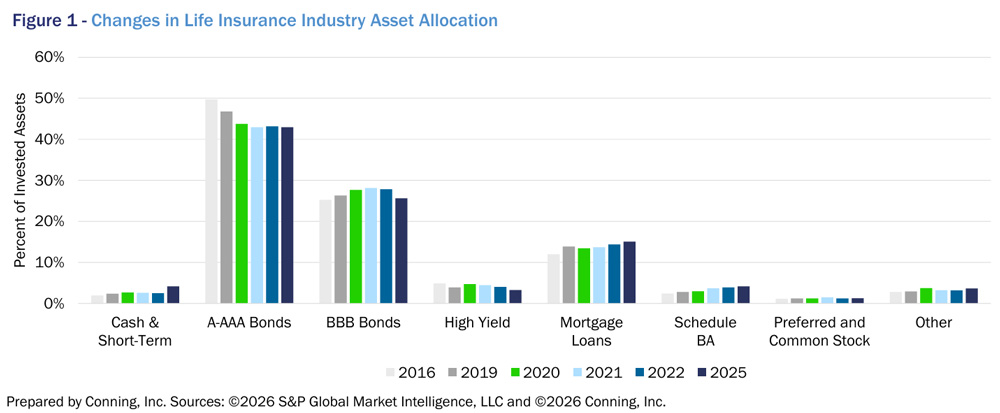
Over the past decade, the life insurance industry has steadily adjusted portfolio allocations in response to changing interest rate environments, evolving liability needs, and expanding investment opportunities.Some of these changes have been tactical, while others reflect broader shifts in how insurers approach liquidity, portfolio income, and diversification (see Figure 1).
Footnotes
1. ©2026 S&P Global Market Intelligence
About Conning
Conning is a leading investment management firm with a long history of serving insurance companies and other institutional investors. Conning supports clients with investment solutions, risk modeling software, and industry research. Founded in 1912, Conning has investment centers in Asia, Europe and North America. Conning is part of Generali Investments.
Legal Disclaimer
©2026 Conning, Inc. Conning, Inc., Goodwin Capital Advisers, Inc., Conning Investment Products, Inc., a FINRA-registered broker-dealer, Conning Asset Management Limited, and Conning Asia Pacific Limited (collectively “Conning”) and Octagon Credit Investors, LLC, Global Evolution Holding ApS and its subsidiaries, MGG Investment Group LP and certain of its affiliates, and Pearlmark Real Estate, L.L.C. and its subsidiaries (collectively “Affiliates” and together with Conning, “Conning & Affiliates”) are all direct or indirect subsidiaries of Conning Holdings Limited which is one of the family of companies whose controlling shareholder is Generali Investments Holding S.p.A. (“GIH”) a company headquartered in Italy. Assicurazioni Generali S.p.A. is the ultimate controlling parent of all GIH subsidiaries. Conning & Affiliates have investment centers in Asia, Europe and North America. This document and the software described within are copyrighted with all rights reserved. No part of this document may be distributed, reproduced, transcribed, transmitted, stored in an electronic retrieval system, or translated into any language in any form by any means without the prior written permission of Conning & Affiliates. Conning & Affiliates do not make any warranties, express or implied, in this document. In no event shall any Conning & Affiliates company be liable for damages of any kind arising out of the use of this document or the information contained within it. This document is not intended to be complete, and we do not guarantee its accuracy. Any opinion expressed in this document is subject to change at any time without notice.
This document is for informational purposes only and should not be interpreted as an offer to sell, or a solicitation or recommendation of an offer to buy any security, product or service, or retain Conning & Affiliates for investment advisory services. The information in this document is not intended to be nor should it be used as investment advice.
Copyright 1990-2026 Conning, Inc. All rights reserved.
COD00002819
Additional Source Information
This Conning publication uses data sourced from Copyright 2026, S&P Global Market Intelligence LLC. Reproduction of any information, data or material, including ratings (“Content”) in any form is prohibited except with the prior written permission of the relevant party. Such party, its affiliates and suppliers (“Content Providers”) do not guarantee the accuracy, adequacy, completeness, timeliness or availability of any Content and are not responsible for any errors or omissions (negligent or otherwise), regardless of the cause, or for the results obtained from the use of such Content. In no event shall Content Providers be liable for any damages, costs, expenses, legal fees, or losses (including lost income or lost profit and opportunity costs) in connection with any use of the Content. A reference to a particular investment or security, a rating or any observation concerning an investment that is part of the Content is not a recommendation to buy, sell or hold such investment or security, does not address the suitability of an investment or security and should not be relied on as investment advice. Credit ratings are statements of opinions and are not statements of fact.